

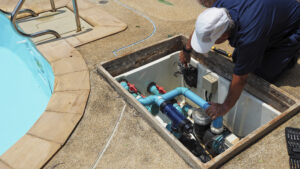
Your pool pump runs quietly in the background day after day, keeping water circulating, filtered, and clean. So when it suddenly starts grinding, screeching, humming, or rattling, it is hard to ignore — and easy to worry. If your pool pump is making unusual noises at your Anaheim home, the sound itself is often a clue about what is wrong and how serious the problem is. Here is what different noises typically mean and how to decide whether repair or replacement is the right move.
Grinding or Screeching Noises
A grinding or screeching sound coming from your pool pump is one of the more urgent warning signs. This type of noise typically points to worn or failing bearings inside the pump motor. Bearings allow the motor shaft to spin smoothly, and when they degrade — often due to age, moisture intrusion, or prolonged strain — the metal-on-metal contact produces that distinctive harsh sound.
In some cases, a bearing replacement can resolve the issue at a reasonable cost. However, if the motor is older or if the bearings have been failing for a while, the internal damage may be more extensive. A thorough inspection will determine whether a targeted repair makes financial sense or whether a new, energy-efficient motor is the smarter investment.
Rattling or Vibrating Sounds
A rattling pump is not always a sign of a serious mechanical failure. Common causes include debris — small pebbles, leaves, or other material — caught inside the pump basket or impeller. A clogged or partially blocked impeller forces the pump to work harder and can produce vibration and rattling as water flow is disrupted.
Rattling can also result from loose mounting hardware or a pump that has shifted on its base over time. In many cases, clearing the obstruction or resecuring the pump resolves the noise quickly. Left unaddressed, however, an obstructed impeller puts strain on the motor and can lead to more costly damage down the line.
Humming Without Full Operation
If your pump hums but does not seem to be moving water effectively — or struggles to start — this often points to a capacitor issue. The capacitor helps the motor start up and run at full capacity. A failing capacitor is a relatively straightforward and affordable repair in most cases, making this one of the better scenarios when pump problems arise.
A humming pump can also indicate that the motor is receiving power but is seized or jammed, which requires immediate attention to avoid burning out the motor entirely.
Repair or Replace — How to Decide
This is the question most Anaheim pool owners face once a problem is diagnosed. A few factors help guide the decision. If the pump is relatively new and the repair cost is modest, fixing the existing unit usually makes sense. If the pump is more than eight to ten years old, repairs may only delay the inevitable — and newer variable-speed pumps offer significantly better energy efficiency that can reduce operating costs month after month.
Honest, practical advice on this question is something Tanner & Son's Pool Services & Repairs takes seriously. We will never recommend a replacement you do not need, and we will never push a repair when a new unit is clearly the better long-term value.
Get Your Pump Inspected by a Professional
Strange noises from your pool pump should not be ignored. Catching a problem early almost always means a less expensive fix and less disruption to your pool’s operation.
If your pool pump is making noise in Anaheim, call (714) 269-6479 today to schedule an inspection with Tanner & Son's Pool Services & Repairs. We will diagnose the issue and give you a clear, honest recommendation.